
From Prompt to Production: The Architecture of AI Application Builders
An engineering deep dive into the 5-stage compilation pipeline of modern AI application builders—from natural language intent parsing and DAG task planning to in-browser AST execution, self-healing compiler loops, and multi-platform export.
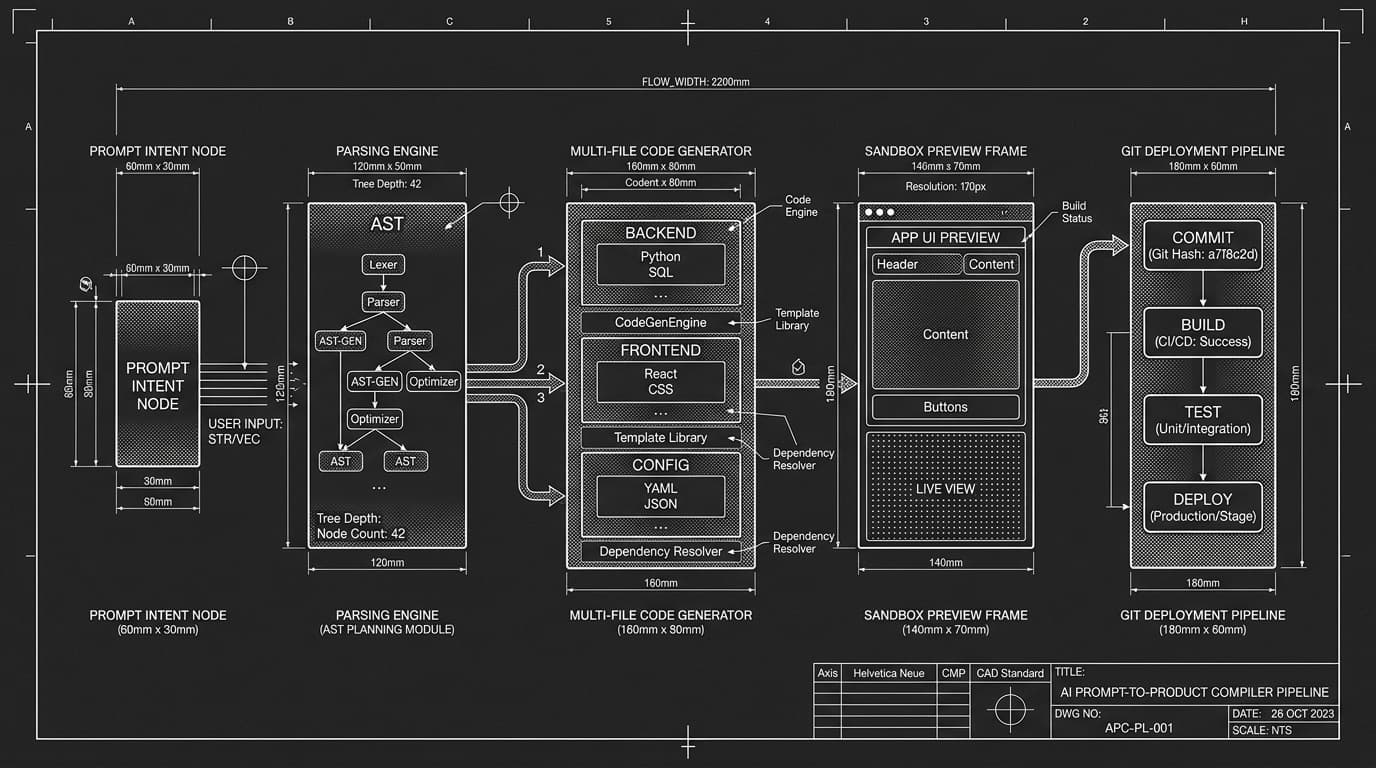
Over the past four years, the developer experience of AI-assisted software creation has undergone a profound architectural shift. The earliest phase centered on inline token autocompletion: statistical models predicting the next few lines of code inside an editor. The second phase introduced conversational chat panes: developers prompting language models to generate individual functions or code diffs, which humans then manually copied into their codebases.
While useful, both paradigms suffered from a critical limitation: they treated software as disconnected text files rather than interconnected, multi-layer systems. Modern applications are not collections of isolated diffs—they are coordinated graphs of relational database schemas, server-side data loaders, client-side state machines, and responsive presentation layers.
Modern AI application builders resolve this by operating as full-stack software compilers. Below is an architectural deep dive into the 5-stage pipeline that transforms high-level intent into deployable, production-ready software.
Stage 1: Semantic Intent Parsing & Specification Synthesis
When a developer submits a prompt—such as 'Build a multi-tenant client portal with role-based permissions, invoice downloads, and an analytics overview'—a naive model immediately starts emitting code. This inevitably fails because key architectural assumptions remain unstated.
A robust application builder first runs Semantic Intent Parsing. The model decomposes natural language into a formal Product Requirements Document (PRD) and deterministic JSON specification that explicitly defines:
- ›Entity-Relationship Models: Primary keys, foreign key constraints, indexes, and nullability rules.
- ›Authentication & RBAC Matrix: User roles (e.g., Admin, Member, Guest) and route-level authorization gates.
- ›Route Tree Taxonomy: File-based routing structures for public, authenticated, and administrative screens.
- ›External Service Dependencies: Payment processing, transactional email, and storage requirements.
Stage 2: Directed Acyclic Graph (DAG) Plan Generation
Generating an application requires strict topological ordering. Attempting to write a React form component before defining its server validation schema or database migration leads to immediate compilation failures.
The builder constructs a Directed Acyclic Graph (DAG) that schedules file emissions according to dependency relationships:
By following this topological sequence, every downstream component imports types and functions that have already been generated and validated.
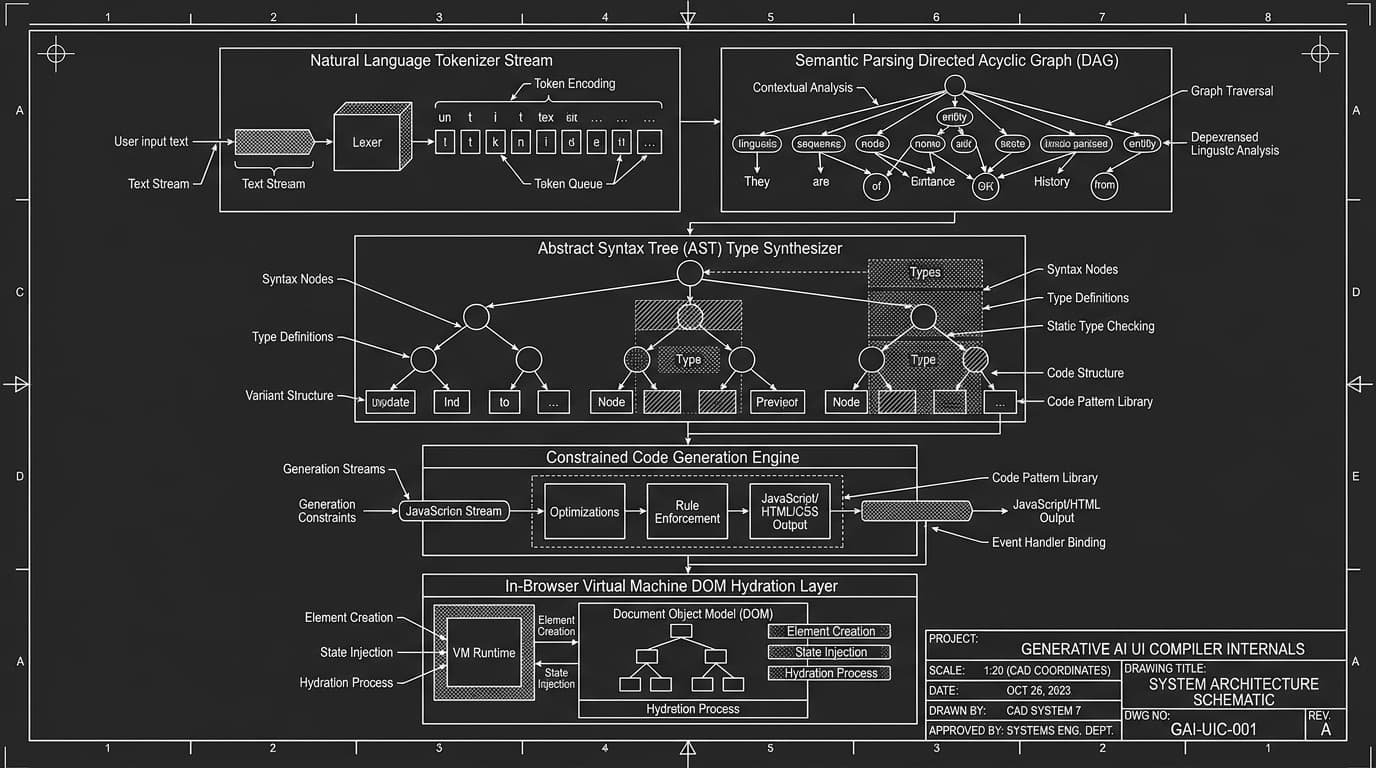
Stage 3: Abstract Syntax Tree (AST) Generation & In-Browser Execution
Traditional cloud development environments require spinning up remote virtual machines or Docker containers, introducing 30 to 90 seconds of cold-start latency. Modern AI application builders bypass this using in-browser WebContainer technology.
A WebContainer runs a lightweight Node.js runtime entirely inside browser WebAssembly. As the AI generates files, they are written to a virtual in-memory filesystem. The in-browser runtime boots Next.js or Vite, compiles the TypeScript Abstract Syntax Tree, and renders a live, interactive preview in milliseconds.
Stage 4: Self-Healing Error Recovery Loops
Even with advanced reasoning models, initial code passes can encounter syntax issues, missing peer dependencies, or runtime exceptions. In naive chatbots, a build failure requires the developer to manually copy the stack trace and re-explain the context.
Modern application builders incorporate an automated, closed-loop diagnostic recovery circuit:
How autonomous compilers detect and repair runtime exceptions without human intervention
| Pipeline Stage | Automated Action | System Outcome |
|---|---|---|
| 1. Diagnostic Capture | Webpack/Turbopack compiler intercepts TypeScript errors and stack traces | Structured JSON error payload generated with exact file, line, and AST node |
| 2. Context Packaging | Error trace is paired with the original specification and affected file contents | Bounded diagnostic prompt prepared without context pollution |
| 3. AST Patch Mutation | Model synthesizes a minimal surgical AST patch rather than rewriting entire files | Virtual filesystem applies diff and re-triggers hot module replacement |
| 4. Health Verification | Test runner or health check verifies successful runtime mount | User receives a fully functional preview without manual debugging |
Stage 5: Multi-Target Portability & Code Ownership
The ultimate test of any AI development system is what happens when you leave the platform. Builders that rely on proprietary cloud runtimes or hidden dependencies create developer lock-in.
A production-grade application builder outputs 100% standard, open-source TypeScript code: Next.js 15 App Router with Tailwind CSS for web targets, and Expo React Native for cross-platform iOS and Android targets. The codebase can be exported to GitHub, audited by security teams, and deployed to standard cloud providers (Vercel, AWS, Cloudflare) with zero proprietary vendor constraints.
Orbit: Implementing the 5-Stage Compiler Pipeline
Orbit by Forion was engineered from the ground up as a reference implementation of this continuous compiler architecture. Rather than treating prompts as disposable chat queries, Orbit maintains your prompt as the persistent spine of the project.
It synthesizes architectural plans before file generation, executes in-browser WebContainers for instant feedback, heals build diagnostics autonomously, and connects directly to live database Sources (PostgreSQL, Supabase) with complete code sovereignty.
Frequently Asked Questions
- [Q]How does an AI application builder differ from an AI coding assistant?
- An AI coding assistant (like GitHub Copilot or Cursor) operates inside an existing IDE to provide inline autocompletions and localized file diffs. An AI application builder functions as a full-stack compiler: it plans architecture across multiple files, designs database schemas, compiles running previews in-browser, and heals build errors autonomously.
- [Q]Can applications generated by AI builders scale to production?
- Yes, provided the builder emits clean, standard architectural patterns. By utilizing standard Next.js 15 App Router conventions, strict TypeScript interfaces, and relational database schemas without proprietary runtime wrappers, the generated code can be maintained and scaled like any handcrafted engineering project.
- [Q]What is Orbit by Forion?
- Orbit is Forion's flagship AI software development platform and application builder. It turns natural language instructions into fully structured web and mobile software with live previews, database source grounding, and one-click GitHub code export.
[ CROSS-REFERENCES · EXPLORE RELATED SOFTWARE ARCHITECTURE AND AI DEVELOPER RESOURCES: ]
Build with Orbit AI Developer Workspace
Connect live databases, generate native Expo mobile codebases, and eliminate fragmented subscriptions inside one continuous environment.