

Describe what you want to build.
Orbit compiles the rest.
The unified browser workspace where natural language compiles directly into production software. Chat with AI, inspect live code, and iterate in real time — with zero local configuration.
“Build a fitness tracking app with user auth, workout tracking, progress charts, and mobile view.”
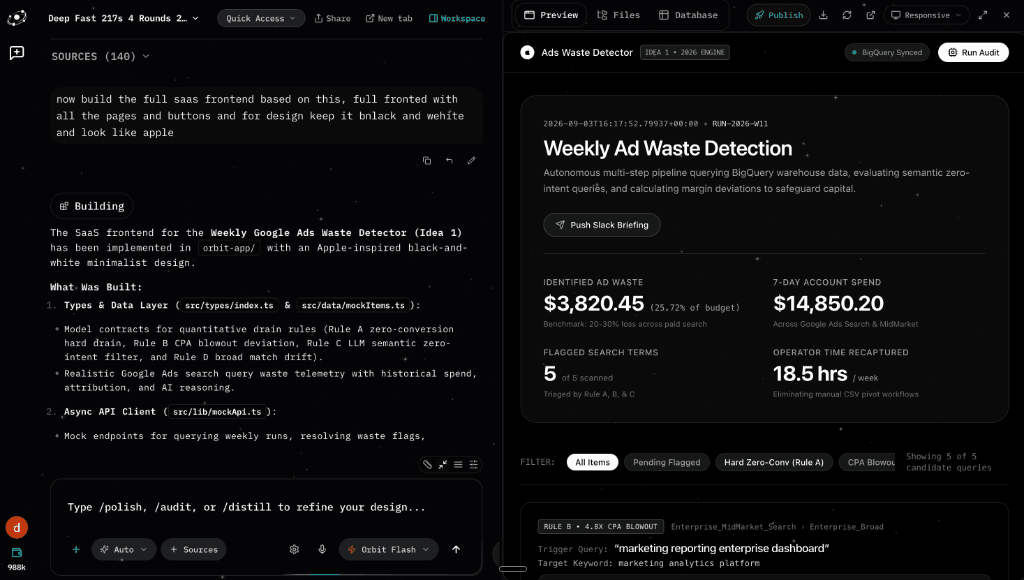
Four output targets.
One unified workspace.
Orbit doesn't output toy prototypes. It outputs clean, typed, modular codebases structured according to modern full-stack standards.
Next.js 16 + Supabase
App Router architecture with real Postgres schema, Row-Level Security, user authentication, and Stripe payments.
Expo React Native
Cross-platform native iOS & Android applications with native navigation, gestures, and persistent device storage.
Vite React + Tailwind
Lightning-fast single-page applications with instant HMR in-browser, custom components, and Framer Motion effects.
HTML5 / CSS3 / ES Modules
Zero-dependency standalone code for hyper-optimized landing pages, embeddable widgets, and lightweight tools.
The modular architecture of Orbit OS.
Orbit
Chat Workspace
An AI conversational workspace that acts as the control center for your workflows.
Deep Research
Multi-round fact-finder that crawls the web, cross-checks claims, and writes reports.
Build Mode
Constructs fully functional web and mobile applications with pre-configured backends.
Interactive Artifacts
Generates interactive files—dashboards, quiz guides, slides, and games.
Business Intelligence
Visualizes data insights with interactive charts, KPI dashboards, and automated report generation.
Media Generation
Creates production-grade images and storyboarded video sequences from prompts.
E-Commerce Storefronts
Generates complete cart systems, Stripe checkout endpoints, and inventory databases in one click.
Engineered for production.
Not throwaway prototypes.
Every detail in Orbit is calibrated to ensure your generated software is clean, maintainable, and ready to scale.
Visual Persona Intelligence
Orbit determines your app’s visual language before writing code. A fintech dashboard gets tight data density and sharp lines; a wellness app gets organic breathing movement.
Design System Token Lock
Every component references the same unified token set. Button corner radius matches the modals, while padding scales proportionally across views automatically.
Motion-First Generation
Motion is not an afterthought. Hover states, drawer slide-overs, page transitions, and skeleton loaders are baked into the generated React output.
Click-to-Annotate Surgical Edits
Click any element in the live preview to pin it. Your next instruction touches only that specific component without regenerating or breaking other files.
In-Browser WebContainers
Runs a real Vite development server directly inside your browser. Experience instant HMR, npm packages, and terminal logs with zero server latency.
Integrated Backend & Auth
Automatically hooks up PostgreSQL schemas, user accounts, JWT sessions, and row-level security policies without manual database provisioning.
Web & Native Mobile Stacks
Output Vite React for single-page applications, Next.js for full-stack platforms, or Expo React Native for real iOS and Android native apps.
Zero Platform Lock-In
Orbit produces standard, idiomatic React, Tailwind, and TypeScript. Export your repository anytime to continue building locally or deploy to Vercel and AWS.
E-Commerce from
the input bar.
The New Era of Conversational Commerce.
No complex admin dashboards or setting sheets. Orbit introduces instant storefront creation, live inventory management, and Stripe checkouts directly from a single conversational prompt.
Instant Store Creation
Orbit generates a complete online shop automatically. It builds beautiful product layouts, cart settings, and Stripe checkouts instantly, without you needing to write code.
Simple Store Management
Update inventory and manage your storefront just by talking to Orbit. Modify product prices, add stock, configure coupon codes, or issue customer refunds conversationally.
Sales & Analytics
Get clear summaries of how your shop is performing. Orbit tracks incoming orders, calculates your sales, and compiles store records into clean, easy-to-read charts.
All from One Place
Breaking and removing the traditional way of e-commerce store handling. Say goodbye to complex admin dashboards and tab switching—manage your entire business from one simple conversational bar.
Curated foundations.
Ready to deploy.
SaaS Platform
Next.js 16 + Supabase auth, Stripe subscriptions, team workspaces, and telemetry.
Fitness & Health App
Expo React Native workout tracker, activity streaks, health sensors, and offline cache.
AI Streaming Workspace
Vite React AI interface with token streaming, model selection, and prompt canvas.
Autonomous Storefront
Modern store with dynamic product catalog, inventory management, and 1-click checkout.
Community Forum
Realtime threads, markdown replies, user profiles, and karma moderation system.
Executive Analytics
Interactive KPI charts, conversion funnel diagnosis, and automated export reports.
Straight technical answers.
Launch Orbit.
Your product is minutes away.
No local configuration. No missing dependencies. Turn ideas into production code, review live previews, and ship on your own terms.