
Can AI Generate Production-Ready React Code in 2026? A Senior Engineer’s Audit
We audit AI-generated React code against production standards: TypeScript strictness, React 19 server actions, accessibility (a11y), and bundle performance.
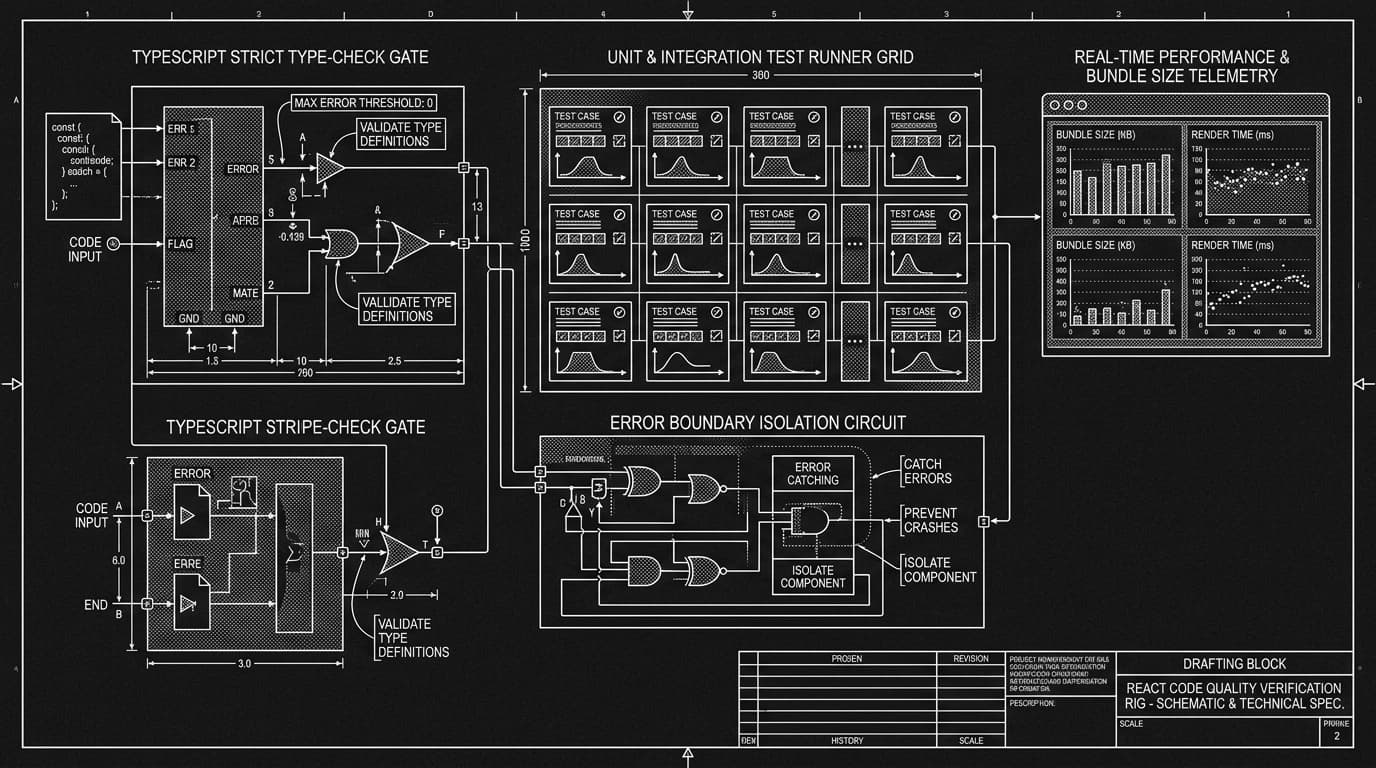
The 5 Non-Negotiable Tests for Production React Code
In professional software engineering, whether a piece of code was written by a junior human or an AI model is secondary. What matters is whether the code satisfies five production criteria:
- ›TypeScript Strict Mode: Does the code compile with zero errors under noImplicitAny, strictNullChecks, and exactOptionalPropertyTypes?
- ›Server vs. Client Boundaries: Are React 19 "use client" directives used sparingly at the leaves of the component tree, keeping data fetching on the server?
- ›Accessibility (a11y): Are form inputs associated with labels, buttons provided with accessible names, and interactive widgets equipped with proper ARIA attributes?
- ›Performance & Tree Shaking: Does the bundle import lightweight individual primitives or does it drag in 500kb monolithic icon packages and unnecessary dependencies?
- ›Resilient State Management: Are loading skeletons and error boundaries built into the component structure rather than added as an afterthought?
Real-World Benchmark: AI Output vs. Production Standard
Comparing unconstrained LLM output, basic AI builders, and compiler-verified systems
| Code Quality Metric | Generic LLM Chatbot | Basic Prototype Builder | Compiler-Verified Builder (Orbit) |
|---|---|---|---|
| TypeScript Strictness | Frequent "any" & missing prop types | Partial interfaces, untyped events | 100% Strict TypeScript interfaces |
| React 19 Conformance | Outdated React 17/18 patterns | Indiscriminate "use client" everywhere | Optimized Server Components & Actions |
| Accessibility (ARIA) | Usually omitted or broken | Basic button elements only | Semantic HTML & Radix a11y primitives |
| State Machine Discipline | Fragile boolean flags | Basic useState chains | Predictable loading/error/success states |
How Compiler Verification Bridges the Quality Gap
The fundamental breakthrough in 2026 is pairing neural generation with deterministic compilers. When Orbit by Forion synthesizes React code, it executes an automated verification DAG: in-browser TypeScript checks, AST parsing, and bundle analysis occur before the user ever sees the code.
If a compiler error or type mismatch occurs, the system catches it internally, feeds the exact diagnostic message back to the generator, and auto-corrects the syntax in milliseconds.
[ CROSS-REFERENCES · RELATED ENGINEERING GUIDES & SOLUTIONS ]
Frequently Asked Questions
- [Q]Does AI-generated React code introduce security vulnerabilities?
- Unchecked code can introduce XSS or SQL injection vulnerabilities if parameters are concatenated as raw strings. Modern systems like Orbit use parameterized SQL and sanitized React JSX to eliminate these injection vectors.
- [Q]How do you prevent AI from using deprecated React patterns?
- By constraining the prompt context and grammar with explicit React 19 documentation and enforcing strict lint rules that flag deprecated lifecycle methods or outdated hook patterns.
- [Q]Can AI-generated code be safely committed to an existing enterprise repo?
- Yes, when the output is standard TypeScript with zero proprietary runtime dependencies. Teams export Orbit codebases directly to GitHub and run their existing CI/CD test suites without modifications.
Build with Orbit AI Developer Workspace
Connect live databases, generate native Expo mobile codebases, and eliminate fragmented subscriptions inside one continuous environment.